
Showing posts with label KLSE Watchlist. Show all posts
Showing posts with label KLSE Watchlist. Show all posts
Monday, October 7, 2013

Wednesday, September 4, 2013
Supermax Corporation - Full Steam Ahead!
We came away from a meeting which was hosted by Dato’ Seri Stanley Thai feeling excited about Supermax’s (“SUPERMX”) growth prospects. We believe that SUPERMX is on track to deliver mid-double digits growth over the next two years. Our meeting included a visit to its two new plants followed by a briefing. The key takeaways from SUPERMX company visit include: (i) new plants progressing well, (ii) new capacity’s net margin ranges between 9% to 11%; and (iii) new capacity from factory Lot 6058 & 6059 to come on-stream by 4Q13. Valuation-wise, the stock is trading at steep discounts to its peers. SUPERMX’s PERs of 11x and 10x on FY13E EPS and FYE14 EPS respectively is at a steep 40% discount to sector average. This is unjustified given its potential net profit growth averaging 15% p.a in FY13E and FY14E. Maintain OUTPERFORM. Our TP is RM2.82 based on 12x FY14E EPS.
New plants progressing on track. Firstly, we visited Lot 6070 located in Meru, Klang (the conversion of the old latex-based lines into 12 new nitrile lines with 1.43b pieces capacity has started commercial production since 1Q13) where automation installations such as automated mechanical stripping system (removing nitrile gloves from moulds) and glove puller and stacker system are now fully operational. The only process which is yet to be automated is packing of gloves of which some fine-tuning is now currently undertaken before implementation. Looking ahead, once the manual labour of packing gloves in boxes is automated, total savings from automation of about 40-50% on the existing labour costs are expected or approximately RM20 to RM25m per annum. Specifically, SUPERMX achieved a cost saving of up to 60% from automated stripping and stacking implemented in its Kamunting plant. Subsequently, we were taken to the site of both Lot 6058 and Lot 6059 located directly at the back of Lot 6070 where building works is progressing and on track to be commercially ready between end 4Q13 to 1Q14. These new plants will have lines that are switch-able between natural rubber and nitrile glove production but have currently been earmarked for nitrile gloves in tandem with market demand.
New capacity’s net margin ranges between 9% to 11%. In anticipation of intense competition, management guided that average selling price (ASPs) for the new gloves capacity is priced such that net margin ranges between 9% and 11%. Although this is slightly below our 11.9% net margin forecast in FY14, we are not overly concerned. This is simply because SUPERMX is gradually automating its production processes starting from Lot 6070. Next, the two new plants in Lot 6058 and Lot 6059 in Meru, Klang when completed by early 1Q14 is expected to be fully automated from automated mechanical stripping to packing of gloves leading to improve production efficiency. As such, we believe overall margins could improve due to better productivity and efficiency from the new plants. Additionally, unlike other glove players, SUPERMX does not face the risk of high downtime on production lines since they do not cater much for clients requesting for a single product type and specification needs, thus reducing idle downtime from frequent machinery setting adjustments to accommodate such requirements.
Growth expected from 2 new plants going forward. The two plants namely Lot 6059 and Lot 6058 are on track to commission commercial productions gradually, between end 4Q13 or early 1Q14. Lot 6059 and 6058 will have 24 and 16 production lines producing 3.2b and 2.2b pieces of nitrile gloves respectively. This will bring its total nitrile production capacity from 6.9b (including the 1.4bn in Lot 6070) to 12.3b pieces p.a. or 52% of the total installed capacity. Due to strong demand for nitrile gloves, SUPERMX is currently facing an oversold position of two to three months. An estimated first twelve lines and 1.4-1.6b pieces of gloves are expected to come on stream between end 4Q13 and 1Q14. For illustrative purposes, assuming a net profit margin of 10%, ASPs of USD27/1000 pieces and 80% utilisation (based on 5.5b pieces), this would generate a total net profit of RM38m or 24% of FY14 net profit.
Beneficiary of weakening Ringgit against the US dollar. SUPERMX is a beneficiary of the weakening Ringgit since they do not hedge its US dollar receipts. Since sales are USD denominated, theoretically, a depreciating ringgit against the dollar will lead to more ringgit revenue receipts. The ringgit has weakened by 10% to RM3.30 from an average of RM2.99 against the dollar over the past several weeks. Ceteris paribus, a 1% depreciation of RM against USD will lead to an average 1%-2% increase in the net profit.
Trading at an average 40% discount to the sector average. SUPERMX’s YTD share price performance (+20%) is still lagging other players such as Kossan (+90%), Hartalega (+40%) and Topglv (+10%). Since our upgrade report in Feb 2013, the stock has risen by 20%. A re-rating of the stock is imminent as the latest 2Q13 results registered margin improvement, which dispelled market scepticism that SUPERMX may be unable to implement cost pass-through to counter the higher cost from the minimum wage. Maintain OUTPERFORM with a TP of RM2.82 based on 12x FY14 EPS (The targeted PER is at +1.0SD level above the 5-year historical average).
Source : Kenanga
Tuesday, August 27, 2013
Answers to the comments and queries on Jaya Tiasa
As the author I expect readers to comment and query sensibly. Here are my answers to the query submitted on my previous article about Jaya Tiasa:
The test of the pudding is in the eating. As you know the market index has been dropping and since I recommend you to buy JT has the price dropped and have you lost money?
What will happen to all your other shares in your portfolio if the market continues to drop for another few months?
1. If JT is so good why should Koon tells everybody to buy? Is he sincere?
Most of my wealth is from the stock market and I am giving away almost all my money to charity. When you click open the Malaysia Finance blogspot site or Lim Kit Siang blog, you will see my advertisement ‘Koon Yew Yin Scholarship’ offer. I must thank Dali and Kit Siang for putting up the advertisement free of charge. Up to date I have helped about 150 poor students to complete their degree courses. You may like to know my philosophy in doing charity.
The amount I acquired is not important. The amount I give away that matters.
The knowledge I have acquired is not important. The knowledge I share with you that matters.
The amount I acquired is not important. The amount I give away that matters.
The knowledge I have acquired is not important. The knowledge I share with you that matters.
I am very good in making money from the market and I want to share my knowledge. I am sincere and whether you buy or not will not benefit me but I would feel happy to see my recommendation come true and you have made more money. It is another form of charity I do.
2. Why should you buy JT when the profit for the last few years is so poor?
Most professional fund managers and punters consider current EPS & P/E ratio are the most important. That is why they all do not want to buy JT. As a result the share price has been depressed around Rm 2.00 for almost a year. Since it is on cheap sale, why don’t you buy?
Fund managers and people who buy shares just basing P/E ratio must examine their performance record. Can you beat the market index? Can you double your money in 2 or 3 years? Statistics show that more than 80 % of fund managers and most investors cannot beat the index.
3. Avoid JT because it has too much borrowings:
The total borrowing is very small compare with their assets. JT is the largest producer of plywood and sawn timber. They have used the money from the wood business to plant 62,000 ha planted of oil palms. They have also planted tens of thousand hectares out of 235,000 ha of forest with fast-growing tree species such as Eucalyptus and Kelampayan and they are continuously planting. It takes 12-15 years for the trees to mature before they can use them for their plywood manufacture. All the cost of planting is from their timber business and they are saving the profit for the shareholders. It is like buying raw material in advance for their plywood manufacture. That is why JT is not showing much profit.
Do you know how to value this large tract of land which is about twice the area of Singapore?
To borrow money to do business or buy shares is a smart way to make more money. As long as you are confident to make more than the interest rate, you should borrow.
How to become a super investor?
The best way to show you how to improve your method is by explaining why I believe I can double my money in 2-3 years buying Jaya Tiasa.
Sustainable Profit Growth Prospect Is Most Important Criterion
It is easy to master all the basic fundamental principles in stock selection. Most fund managers and investors consider the current EPS is the most important, but I disagree. They believe the current earning will support the share price. What happens when the shares they bought show a reduced EPS in the next quarter? The share price drops and they would lose money.
The most important criterion, in my opinion is ‘good profit growth prospect’. I will not buy a stock which does not have this quality. In other words – buy on solid evidence of good profit growth and not on the basis of speculation or hot tips!
I will never buy any stock however cheap it is in term of P/E ratio if I am not sure of its sustainable profit growth in the next few years.
You must remember that when the current earning is good, everyone can see it and you cannot buy it at a bargain price. Jaya Tiasa has very poor current earning and most people cannot wait or foresee its fantastic profit growth prospect. That is why the share price has been depressed in the last couple of years and you can buy it at basement sale price. You may have to wait a little longer before more investors see the real growth potential of JT.
To illustrate this important point of long term profit growth prospective, I have extracted the following figures from its annual reports.
Being a leader of the timber and plywood industry, it has not been showing much profit because they have used the cash from the timber business to plant oil palms. It started planting oil palms in 2002 aggressively and the following tables show the planted area and it’s FFB production.

The total planted area and the FFB production have been increasing rapidly since 2005. The palms are physically growing and producing more and more fruits every year. I can foresee that JT will have sustainable growth in the next 10 years. I was told that when the palms start to bear fruits, they cannot capitalize the expenditure. That is why the profit is so poor because most of the palms are young. Look at the palm age profile and FFB production charts below.
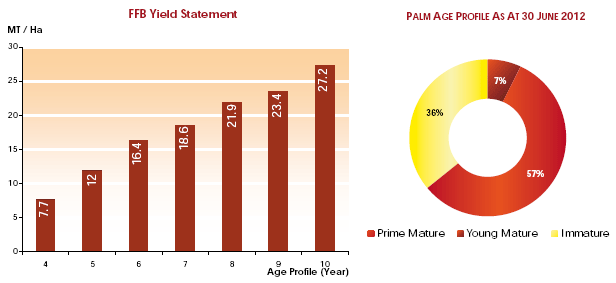
When the palm is 4 years old, it produces 7.7 ton per ha per year. When it is 10 years old it produces 27.7 ton which means that the palm increases production about 3.6 times in 6 years and the additional production cost is only for plucking the additional fruits.
Considering that the company continues to plant more palms every, it is safe to assumed that the FFB production can increase at least 3 times in 6 years. Even if CPO price remains unchanged, its profit from its plantation alone should increase 3 times in 6 years.
You must bear in mind that they have cut down the trees and sold the timber products and use the proceeds to plant oil palms aggressively which are continuously growing and appreciating in value.
The jungle land has turned into oil palm plantation which also must be appreciating in value over the years.
I understand that according to accounting rules the assets cannot be revalued simply to improve its book NTA value. If you buy JT now, you are really buying the most undervalued stock I know.
The devaluation of Ringgit: Recently our Ringgit has been devalued about 8% in comparison with US$. I can foresee that JT will make an additional profit for doing nothing extra because almost all their palm oil, plywood and sawn timber are sold in US$.
Spin off Timber and Plywood business: In the coming AGM, I will propose that the company spin off their timber and plywood business to benefit the shareholders.
Finally I am obliged to tell you that my family members and I have been buying most of shares transacted in the last 6 months and we have accumulated more than 35 million shares. I have never been surer to make money before in my life than now in buying Jaya Tiasa.
Please google my name if you want to know more about me.
by Koon Yew Yin
买激成送依区地皮?
2013-08-26 14:39
激成(KSENG,3476,主板工业产品股)今年派特别股息96仙吗?激成在新山8000多英亩园丘有产业价值吗?
为了获知真相,笔者于六月底出席公司的股东大会。
激成股东大会会议摘要
特别股息柳暗花明又一村
(一)公司审计证实激成拥有大约3亿2000万令吉未分配盈利,能以扣税股息方式派发,但必须在年底前完成。
(二)董事经理表示,公司无意派发特别股息,因需要庞大现金作投资。
(三)股东不满,批评董事部的内容如下:
(1)既然公司需要钱作投资,董事部不该多领150万董事费。
(2)公司最近几年只把数亿令吉现金存入银行赚取低微利息,根本没有什么大投资计划。
(3)公司大股东为大富豪,不稀罕股息,但大部份股东属中等收入人士,董事部应体恤小股东,派特别股息,让小股东向所得税局追回25%退税。
(4)公司即使派发每股1令吉特别股息,只用掉2亿7000万令吉,但淨现金高达7亿9900万令吉,即还有5亿2900万令吉供投资之用,何况另有5亿400万令吉股票可随时套现。
所以,董事部根本无拒绝派特别股息的理由。
(四)最后,董事经理表示,明白小股东们的请求,但董事部须开会讨论才作出决定。
尽管如此,激成仍然有可能来一两个月捎来令人惊喜的消息。
园丘地
依区最大地主
依区最大地主
董事经理斩钉截铁地说,公司位于新山UluTiram以东10公里,Tanjung Langsat工业区以北的8000多英亩园丘,具有产业发展潜能。
但现今无意发展,5年后再考虑,因已有上千英亩地皮供产业发展之用。
如果把激成的1326英亩产业发展地皮和8167英亩有发展潜能的园丘地加起来,激成那9493英亩土地,就超越UEM阳光(UEMS),而成为依斯干达最大的地主。
其实,激成派特别股息,当然是股东们天大的喜讯,但落空的话,也无须太失望,因公司最有价值的并非特别股息,而是其霸级资产,尤其是9000多英亩依斯干达地皮,都是1980年留下的“阿爷地”,价值连城。
总结
股价极度低估
有人花数千元收藏一枚钱币,也有人用数万元投资古董,只因为他们相言其价值。
激成的淨有形资产是每股20.16令吉。
这是根据房地产行情、股票行情的公认标准计算而得。
新加坡籍管理层诚实可靠,所以激成的资产负债表是千真万确的,但股价只有5.20令吉,也许信者不多吧。
今日大马已进入“土地为王”时代,拥有土地的个人与企业越来越富裕,依斯干达经济区将是大马的“深圳”,房地产价如日冲天。
各位想到此地买地做地主,即使是新山地不佬或Pletong区,地价也喊到一英亩80万令吉以上。
3.8万股拥1英亩地
各位不用望地兴叹,若你相信买股票拥有地皮的话,请看下文。
你买1000股激成,就拥有0.02635英亩依斯干达土地;或买3万8000股,就拥有一英亩土地。
各位,看看激成的金库表,单是资产(1)至(7)已值得每股5.47令吉。
现在你以股价低至5.47令吉的价格买入,就是说资产(8)至(11)包括依斯干达土地都是免费赠送。
由此算起,买激成股票送依斯干达地皮非梦也,你相信吗?

Subscribe to:
Posts (Atom)